Overcast vs. Golden Hour: Which Light Works Better for Forest Landscapes?
Walk into a forest at dawn and you will usually find two kinds of photographers. One is waiting for the sun to break through the canopy. The other is quietly hoping it stays behind the clouds. Both are right, which is what makes woodland photography so interesting and occasionally so frustrating.
Soft overcast light and warm golden-hour light do very different things to trees, moss, water and undergrowth. Neither is better in any absolute sense. The useful question is which one suits the photograph you are trying to make, and whether you are willing to work with the weather you have been given.
What Each Light Actually Does
Overcast skies turn the whole sky into one large diffuser. Light arrives from every direction at once, shadows lose their edges, and contrast drops. Colours deepen, especially greens and wet browns, and small details — lichen on a branch, the texture of bark, the veining on a fern — become readable.
Golden hour is directional. Low sun rakes across the scene, picks out edges, and pushes warm tones into everything it touches. In open landscapes this is easy to love. In a forest it is more complicated: the canopy breaks the light into patches, and you get brilliant highlights sitting right next to deep shade.
Why forests are harder than fields
An open field takes golden light evenly. A wood does not. Trunks interrupt the beam, leaves scatter it, and the ground receives a pattern that can look chaotic in a photograph even when it felt beautiful to stand in. That is why so many woodland photographers prefer cloud, and why the ones who chase sun have to be very deliberate about where they stand.
The Case for Overcast: Even, Quiet, Generous
Cloud is the forgiving option, and forgiving is not a weakness. When contrast is low, your camera's dynamic range is not being pushed to its limit, so shadows hold detail and highlights do not clip. You can expose once, check the histogram, and get on with composing.
The mood overcast creates is close to how a forest actually feels on a damp morning: hushed, cool, a little mysterious. Greens sit deep and saturated. Wet rocks and fallen leaves look richer than they do in sun. If it has just rained, go — the colours are at their best and the light is doing you a favour.
What overcast lacks is separation. Without directional light, a wall of trees can flatten into a green-grey mass. The fix is to look for subjects with their own internal contrast: a pale birch against dark conifers, a bright stream against a dark bank, a lone red mushroom on a floor of brown needles. Compose around tonal difference rather than light.
Watch the white balance. Cloudy light renders cool, often blue-cyan, and a straight camera setting can leave foliage looking slightly cold. A small shift toward warmer tones, or simply setting the camera to cloudy rather than daylight, usually brings the scene back to what your eye saw.
The Case for Golden Hour: Edge, Warmth, Drama
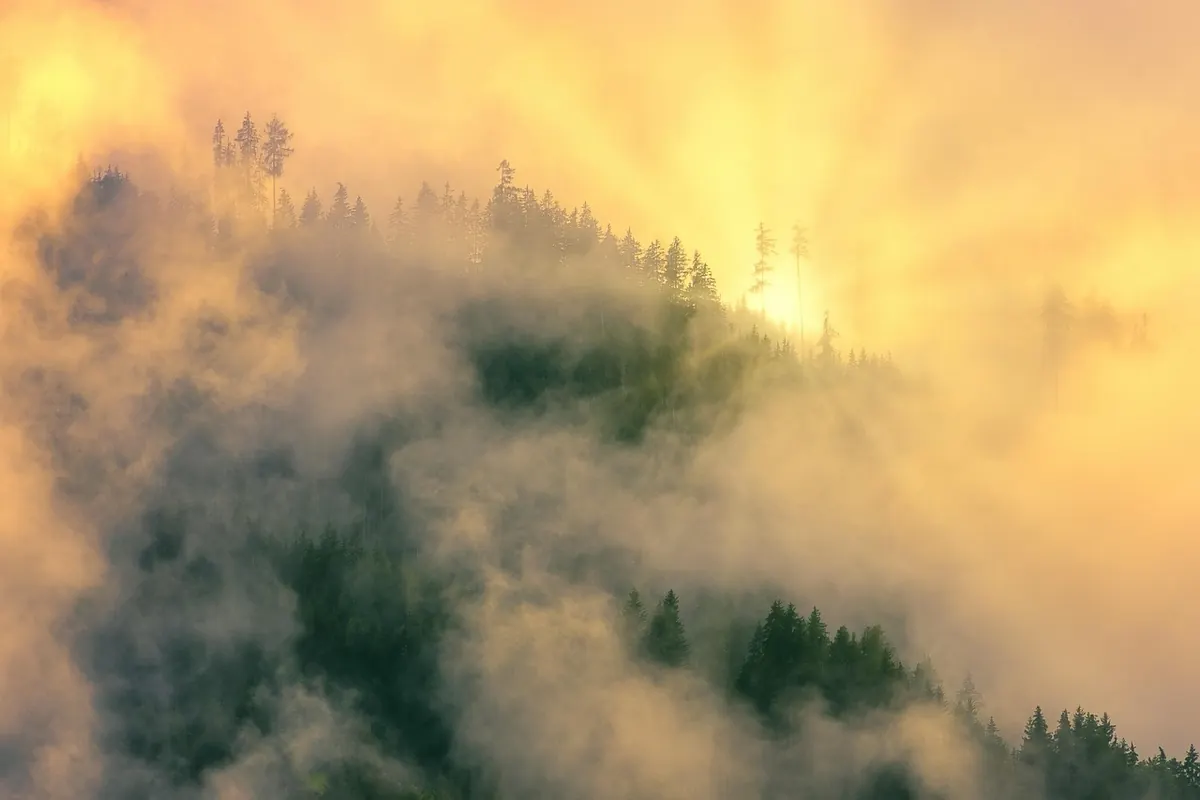
Low sun gives woodland photographs something cloud cannot: direction. Backlight turns leaves translucent, rims trunks with a thin bright line, and lights mist into visible beams. When it works, nothing else looks quite like it.
It works best at the edges. Forest margins, clearings, ride lines, the top of a ridge, a lake shore lined with trees — these are places where the sun can reach in without being shredded by branches. Deep inside a dense wood at golden hour, you often get nothing but scattered highlights on the forest floor and a headache in post-processing.
Timing matters. Golden hour is not a fixed hour. Near the equator it can be twenty minutes; at higher latitudes in winter it stretches much longer, because the sun sets at a shallow angle. Judge it by the sun's height rather than the clock. If the light is already white and hard when you arrive, you have missed it.
Exposure needs care. Bright sky through leaves and dark trunks can exceed what a single frame holds comfortably. Many photographers bracket three or five frames and blend them later, or expose for the highlights and lift the shadows from a raw file. Either way, check the histogram on the spot rather than trusting the screen outdoors.
Contrast, Colour and Mood Side by Side
Comparing the two is easiest in practical terms:
- Contrast: overcast is low and manageable; golden hour is high and demands exposure decisions.
- Colour: cloud deepens greens and cools the scene; low sun adds amber, copper and gold.
- Shadows: soft and open under cloud; long, dark and graphic at golden hour.
- Mood: overcast reads contemplative and honest; golden hour reads romantic and cinematic.
- Forgiveness: overcast tolerates mistakes; golden hour punishes them quickly.
- Duration: overcast lasts all day; good golden light is gone in minutes.
Ask what the scene needs, not what the forecast promised.
Neither column is a ranking. A misty spruce bog at midday under cloud can be a stronger photograph than a sunlit clearing at sunset, if the composition and the moment are better.
Matching Light to Subject
Most woodland subjects have a light they prefer. Before you set up the tripod, decide what you are actually photographing.
- Intimate details — mushrooms, ferns, moss, bark, leaf litter. Overcast, every time. Even light lets the textures speak, and there is no dappling to distract.
- Streams and waterfalls — overcast or deep shade. Low contrast makes long exposures simple and keeps water from blowing out.
- Wide woodland interiors — overcast, ideally with mist or fog. Fog compresses the background into layers and gives the eye somewhere to stop.
- Single trees and silhouettes — golden hour, when the shape is the point and backlighting does the work.
- Autumn foliage — either, for different results. Cloud gives accurate colour and detail; low sun makes leaves glow and lets you shoot into the canopy.
- Mist and beams — golden hour after a cold night. This is the one combination worth rearranging your morning for.
Field Tips That Apply to Both
Some things hold true whatever the sky is doing.
- Carry a polariser. It cuts glare from wet leaves and rock, and deepens green without changing the mood.
- Bring a tripod for overcast work. Low contrast often means low light, and a slow shutter lets you keep the ISO down.
- Mind the wind. In a breeze, leaves blur at anything slower than roughly 1/125 sec. If you want sharp foliage, raise the speed; if you want painterly movement, slow right down and commit to it.
- Shoot raw. Woodland colour is easy to nudge and hard to recover from a compressed file.
- Look behind you. Light in a forest changes direction fast, and the best composition is often on the other side of the path.
- Give it time. Ten minutes of standing still in one spot usually teaches you more about light than ten minutes of walking.
A Practical Closing: Let the Weather Decide, Then Commit
If you have to choose in advance, check the forecast the night before and pick your subject to match. Flat grey sky: head deep into the woods with a macro lens and a tripod, and hunt for details. Clear sky: aim for a forest edge, a clearing or a ridge, and be in position half an hour before the sun gets low.
If the weather does something you did not plan for, photograph it anyway. Plenty of good woodland frames come from a cloudy afternoon that turned out to have fog in it, or from a clear morning you nearly skipped. Light is a condition, not a verdict. Learn what each one is good at, and you will stop waiting for perfect weather and start using the weather you get.
Photo: jplenio / Pixabay